Imagine this scenario:On a Wednesday evening, you’re browsing on your phone, checking out the Model X series from your favorite OOO brand—comparing different models and configurations, but you haven’t made a purchase yet.
Later, based on your in-app browsing behavior, the brand sends you a personalized push notification: “The Model X+ you’re interested in is offering an exclusive test drive experience this weekend. Book now and receive a special gift.”
When you walk into the showroom, the sales consultant already understands your preferred models, budget range, and even knows that you care about battery range and autonomous driving features. They immediately guide you to the most suitable option.
This is what an AI × O2O smart car-buying experience looks like.
In today’s highly competitive retail landscape, “smart retail” has evolved from a competitive advantage into a fundamental capability for brands. As consumers are no longer satisfied with purely online or offline shopping, they now expect a fully integrated “phygital” experience—where physical stores offer real product interaction and human engagement, while digital platforms provide real-time information, personalized recommendations, and seamless purchasing.
At the core of this transformation is AI (Artificial Intelligence). It acts as the engine that converts vast amounts of data into personalized, real-time shopping experiences—enhancing customer satisfaction while significantly improving operational efficiency.
Table of Contents
I. AI-Driven Retail Transformation: From Experience Optimization to Shortening the Purchase Decision Journey
Today, the retail industry stands at the tipping point of a structural transformation. The convergence of generative AI, real-time data analytics, and online-merge-offline (OMO) technologies is redefining the very nature of the consumer experience—no longer a one-time transaction, but an ongoing, data-driven relationship.
According to NielsenIQ‘s recent market observations, nearly 50% of consumers indicated they are willing to accept product recommendations from AI assistants, and are actively leveraging AI to accelerate their everyday shopping decisions. According to a McKinsey survey cited in an ATC report, AI tools have significantly improved demand forecasting and inventory management capabilities.
AI is rapidly permeating every stage of the retail value chain—from customer insights and product recommendations to marketing activation and operational decision-making—fundamentally reshaping how retail operates. In the past, one of the biggest barriers to online shopping was the “uncertainty before experiencing the physical product,” often leading to delayed decisions and high return rates.
However, as AI technologies mature, brands are now able to optimize the consumer journey in more precise and impactful ways:
- Reducing evaluation time: With AI-powered recommendation engines and augmented reality (AR), consumers can experience “try before you buy” digitally—such as virtual makeup trials or in-home furniture visualization. This not only boosts purchase confidence but also effectively reduces return rates, one of the retail industry’s most persistent challenges.
- The rise of intuitive interaction: Advances in Natural Language Processing (NLP) have transformed AI into a “personal stylist” or “intelligent shopping assistant.” Consumers no longer need to rely on rigid keyword searches. Instead, they can communicate naturally—for example, “Help me put together a formal outfit for an outdoor wedding”—and AI can interpret complex needs and deliver accurate recommendations.
- Multilingual and contextual conversations: Modern AI-powered customer service systems now support multilingual and context-aware interactions, providing seamless 24/7 assistance. This shifts retail engagement from one-way information delivery to a more real-time, contextualized customer experience.
Overall, this transformation signals a shift toward a more intuitive, data-driven retail ecosystem. AI enables brands to understand customer needs faster and even anticipate preferences before explicit purchase intent is expressed—allowing for more precise, timely, and relevant interactions.
II. From Data to Performance: How AI Redefines Smart Retail KPIs
The COVID-19 pandemic in 2020 accelerated digital transformation across the retail industry, with smart retail emerging from the integration of big data and AI. Today, technology is not only enhancing efficiency—it is fundamentally reshaping the customer journey and redefining how retail operates.
However, the real challenge is no longer simply about driving in-store conversions, but about connecting every consumer touchpoint across online and offline channels. The modern customer journey is inherently non-linear. Consumers may discover a product through social media, visit a physical store for hands-on experience, and later complete the purchase online. This complex, cross-channel behavior is exactly why O2O has become a critical foundation for smart retail transformation.
Without O2O, brands are essentially operating in the dark—aware that a purchase has occurred, but unable to identify which touchpoints influenced the decision. AI enhances O2O with predictive capabilities, real-time responsiveness, and personalized communication, transforming fragmented data into a dynamic, intelligent closed-loop system.
Today, measuring success in smart retail goes far beyond traditional metrics such as foot traffic or total sales. At its core, smart retail is about turning complex consumer data into actionable business insights. AI plays a central role in this transformation across several key dimensions:
- Personalized recommendation engines: Deliver real-time product suggestions based on user behavior, preferences, and purchase history, increasing engagement and conversion rates.
- Predictive analytics: Use machine learning to forecast demand, identify high-value customer segments, and anticipate optimal purchase timing.
- Omnichannel data integration: Connect multiple touchpoints—including online browsing, offline store visits, app interactions, and payment behavior—to build a unified customer profile.
- Real-time marketing automation: Automatically trigger the most relevant marketing messages and offers based on consumer behavior signals.
As a result, retail performance measurement has expanded from outcome-based metrics to a full-funnel view of the customer journey. O2O ensures that every touchpoint is trackable, while AI ensures that every touchpoint is optimized—making every marketing dollar measurable, attributable, and continuously improvable.
III. Industry Pain Points: The Attribution Gap in Modern Retail
In today’s marketing landscape, the core challenge is often not a lack of traffic, but a breakdown in data attribution. Brands invest heavily in digital channels, generating large volumes of impressions, clicks, and engagement data—yet struggle to clearly determine whether these digital touchpoints actually translate into in-store visits and real-world sales.
This challenge gives rise to several common bottlenecks:
- Data silos: Online behavioral data and offline store visit data remain disconnected, making it difficult to form a unified view of the customer journey.
- Standardized, non-differentiated marketing: Without integrated customer data, brands are unable to deliver personalized communication at scale.
- Fragmented brand experience: Inconsistencies between online and offline interactions create gaps in brand perception, ultimately weakening customer trust.
- Post-campaign validation: Insights are only available after campaigns end, limiting the ability to optimize performance in real time.
- Attribution black box: Brands cannot accurately identify which ads or channels are truly driving offline conversions.
It is clear that the traditional one-way conversion model—using online advertising solely to drive consumers to physical stores—is no longer sufficient in today’s retail environment.
IV. Bridging the Attribution Gap: From Passive Tracking to a Proactive Data Ecosystem
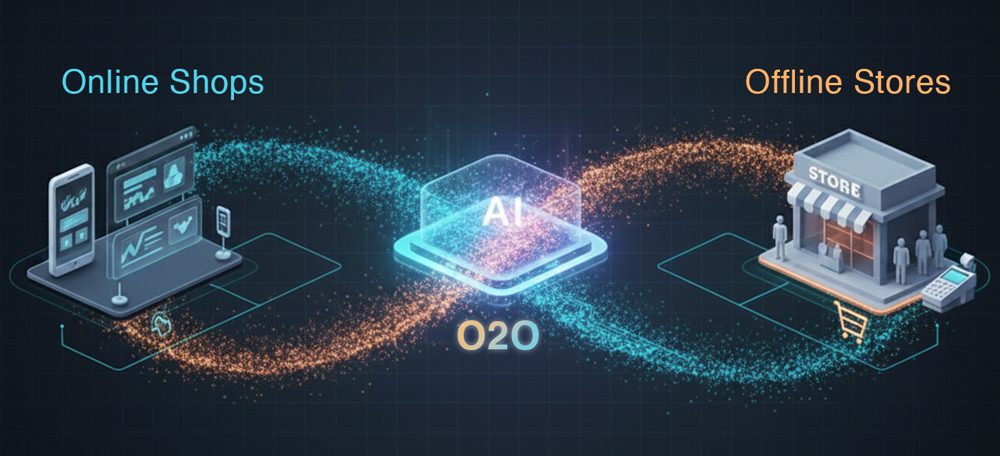
Modern O2O: Beyond “Online-to-Offline” to a Full Closed-Loop System
To strengthen competitive advantage, modern O2O has evolved beyond simply connecting online and offline channels. It now focuses on integrating fragmented data touchpoints into a proactive, AI-driven closed-loop ecosystem—where online behavior influences offline decisions, and offline consumption feeds back into online remarketing. This creates a continuous, self-reinforcing cycle of intelligent growth.
Consumer Behavior as a Verifiable Growth Engine
One of the most critical strategic shifts in smart retail is moving from passive marketing to a proactive, behavior-driven growth model centered around consumer patterns.
Traditionally, the marketing logic followed a linear approach:
launch campaigns → wait for consumer response → passively evaluate results.
In contrast, modern smart retail operates on a fundamentally different model:
- Analyze consumer behavior patterns: Identify behavioral traits and purchase cycles of high-value customers.
- Predict purchase timing: Engage consumers precisely when their purchase intent is at its peak.
- Quantify every touchpoint: Measure each step—from ad exposure and store visits to final conversion.
- Continuously optimize strategies: Use real consumption data to inform and refine the next wave of marketing decisions.
Consumer behavior is no longer just an observational metric—it has become a verifiable, repeatable, and scalable engine for growth.
Quantifiable Effectiveness: The Core Differentiator of Smart Retail
The fundamental difference between smart retail and traditional retail lies in measurability. AI empowers brands to quantify performance at every stage of the customer journey:
- Ad exposure layer: Reach, frequency, and audience targeting accuracy.
- Engagement layer: Click-through rates, depth of interaction, and dwell time.
- Store visit conversion layer: Actual store visit rates after ad exposure and visit timing distribution.
- Purchase conversion layer: Conversion rates, average order value, and product mix.
- Retention and remarketing layer: Customer lifetime value (LTV), repurchase cycles, and churn signals.
Ultimately, the core differentiation of smart retail is not about how much data a brand has, but whether it can translate the effectiveness of each touchpoint into actionable business decisions. AI serves as the critical bridge that turns vast amounts of data into precise, executable actions.
V.Case Study: Delivering Personalized Experiences Through Full-Funnel Touchpoint Tracking
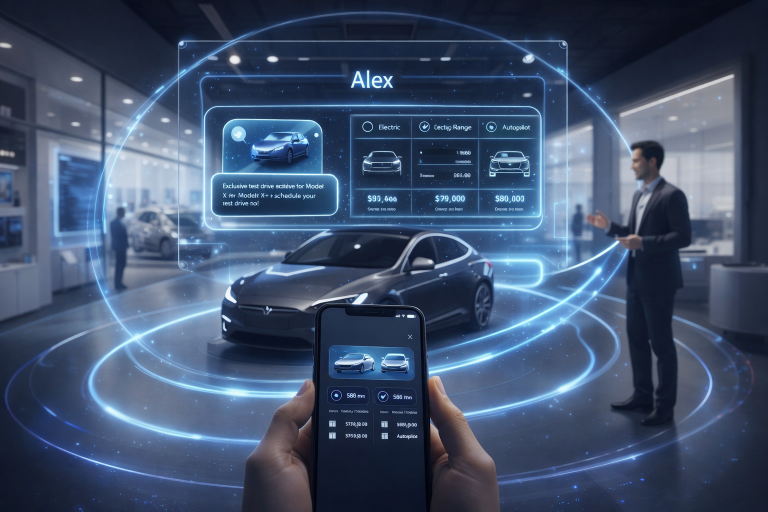
1.Online Interaction (Trigger Point)
On a Tuesday evening, Alex browses the OOO brand’s automotive app, exploring the Model X series. He compares different versions in terms of battery range, features, and pricing, but has not yet made a decision.
The app captures key behavioral signals—including his interests, search queries, preferred price range, and driving needs and habits.
2.O2O Connection (Traffic Activation)
Based on Alex’s in-app behavior, the brand sends a personalized push notification:
“The Model X+ you’re interested in is offering an exclusive test drive experience this weekend. Book now to receive a special gift.”
3.In-Store Experience (Real-Time Validation)
- Which push notification creatives drive higher store visit rates
- Which audience segments respond most strongly to incentives such as test drive gifts
- The average time lag between ad exposure and actual store visits
4.Conversion (Closed-Loop Integration)
Once Alex completes his purchase, the transaction is recorded in the in-store POS system and immediately triggers multiple actions:
- Customer profile update: Alex transitions from a potential buyer to a confirmed “Model X owner.”
- Marketing adjustment: Ads promoting the Model X are automatically suppressed—after all, no one wants to see ads for something they’ve already purchased.
- Next-step prediction: Based on driving behavior and mileage data tracked via the app, the system can estimate when maintenance will be needed. Marketing automation can then proactively schedule service reminders and offer official maintenance incentives at the right time.
This is the new smart car-buying experience enabled by AI × O2O.
Through comprehensive data collection and integration, Vpon helps brands track every touchpoint from online to offline—transforming fragmented interactions into a unified, 360-degree customer view. This enables a seamless connection between online discovery and offline experience.
More importantly, this model is not limited to the automotive industry. It can be applied across retail, beauty, F&B, and beyond—serving as a scalable blueprint for any brand aiming to convert online interest into real-world action.
VI. The Evolution of Vpon O2O: Gaining Optimization Control During Campaign Execution
In the past, data primarily served as a tool for post-campaign performance validation. Brands could analyze impressions, store visits, and sales after a campaign ended to understand which ads drove conversions, and use these insights to refine future strategies. This approach provided valuable feedback, helping marketing teams evaluate outcomes and gradually improve campaign efficiency.
However, as market dynamics accelerate and media costs continue to rise, the need for real-time insights and agile optimization has become increasingly critical. Vpon has evolved its O2O solution into O2O 2.0—an AI-driven data and advertising closed-loop system that transforms the platform from a retrospective analytics tool into an intelligent engine that supports decision-making during active campaigns.
The Power of Proactive Data
Under the O2O 2.0 model, brands no longer need to wait until campaigns end to evaluate performance. Instead, they can monitor key conversion metrics and foot traffic trends in real time—enabling proactive adjustments to media mix, budget allocation, and audience strategies.
This shift from passive observation to actionable insight allows brands to allocate resources more effectively, continuously optimize strategies, and amplify marketing performance throughout the campaign lifecycle.
The Power of Proactive Data
Proactive data is at the core of smart retail. During campaign execution, the Vpon O2O platform continuously collects data—such as ad exposure, engagement, and location-based foot traffic signals.
These real-time insights enable brands to analyze consumer behavior and interaction trends on the fly, dynamically adjusting targeting, budget distribution, and campaign strategy.
This “always-on” intelligence not only improves conversion rates and reduces wasted ad spend, but also enables seamless, context-aware personalized experiences—forming a retail ecosystem that is both predictive and highly adaptive to market changes.
Precision Through Consent-Based Location Intelligence
With user-consented location data, Vpon transforms static data into dynamic journey insights. Brands can understand where consumers are, where they are heading, and engage them with more timely and relevant interactions.
At the point of sale (POS), this data can be cross-validated with membership information, ensuring that each marketing touchpoint can be accurately attributed and effectively executed.
Real-Time Ad Preference Insights
By capturing users’ real-time digital interaction signals, brands can identify what consumers are interested in at the moment—enabling more precise ad targeting and messaging delivery.
By integrating these proactive data capabilities, the Vpon O2O platform establishes a complete intelligent closed-loop system—connecting online interactions with offline behaviors in a verifiable way.
This ability to unify data across touchpoints allows brands to clearly understand the true relationship between foot traffic and conversions, transforming marketing from isolated campaign execution into a continuously optimized, performance-driven growth engine.
Pre-Campaign
- AI-powered audience targeting
- Consumer digital profile building
- Lookalike audience setup
In-Campaign
- Real-time store visit tracking
- Dynamic audience optimization
- Automated budget reallocation
Post-Campaign
- Comprehensive conversion attribution reporting
- ROI measurement and validation
- Strategic recommendations for the next campaign
From Data Observation to Growth Activation
This evolution is not just about gaining faster access to reports—it fundamentally reshapes how decisions are made:
- From post-campaign attribution → to in-campaign strategy optimization
- From outcome evaluation → to continuous, iterative strategy refinement
- From passive analysis → to proactive performance management
Under the Vpon O2O 2.0 framework, data is no longer merely a tool for performance measurement. Through a complete ROI closed-loop validation, marketing shifts from being a cost center to becoming a profit-driving engine—serving as the foundation for both decision-making and business growth.
Brands can continuously accumulate customer insights and refine their targeting strategies, transforming smart retail from one-off campaign success into a scalable and sustainable growth model.
VII.Omnichannel Mastery: Connecting Online Intent with Offline Action in Real Time
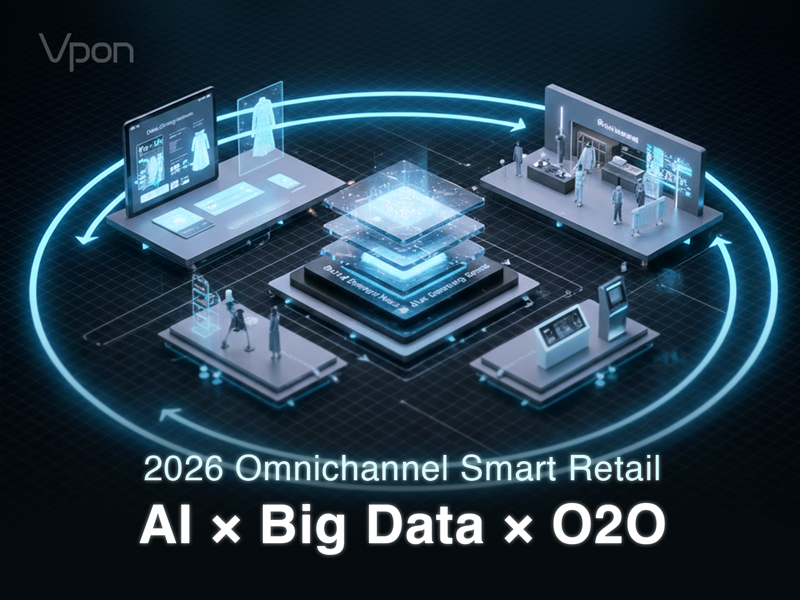
AI-driven smart retail has evolved from a forward-looking concept into a present-day competitive necessity. In this transformation, three core elements define the success equation of modern retail:
- AI intelligence: Transforming massive volumes of consumer data into precise, personalized experiences and predictive insights
- Quantified O2O: Establishing a complete data closed loop to ensure every touchpoint is measurable and attributable
- Real-time activation: Shifting from post-campaign validation to real-time intelligence, enabling rapid response to fleeting market opportunities
The Vpon O2O 2.0 platform embodies the integration of these three elements—powered by AI, fueled by real-time data, and validated through measurable ROI. It empowers brands to build sustainable competitive advantages in the era of smart retail.
More than just solving long-standing attribution challenges, Vpon connects data-driven advertising directly to revenue growth—transforming fragmented digital signals into a continuous engine for business expansion, and enabling the creation of a fully integrated smart retail ecosystem.
In a market where digital and physical experiences are deeply intertwined, what brands need is not just data, but the ability to turn data into actionable insights. In an ever-evolving retail landscape, only those who take control of their data can position themselves precisely—and win—in the omnichannel battlefield.