The global tourism industry is moving from basic service models to technology driven systems. In Taiwan, the Tourism 2030 policy sets the vision of “Building a Country Through Tourism” aiming to strengthen tourism as a national industry and develop smart, digital travel experiences.
The tourism industry today faces many challenges such as labor shortages and rising operating costs. As a result, it is difficult to maintain high service quality and customer experience . Hotels and travel companies are leaning towards tools with automation, Artificial Intelligence (AI), and Big Data to improve destination experiences and connect with visitors. Smart tourism is no longer just a trend, it has become an important approach for building sustainable and high quality tourism for the future.
Table of Contents
1. What is Smart Tourism? Trends and Challenges in the New Era
Defining Smart Tourism
Smart tourism integrates technology like artificial intelligence (AI), big data, location data, and digital systems to improve the tourism industry instead of using separate digital tools with different data silos. This helps improve the traveler’s experience before, during, and after a trip.
Traditional tourism focuses mainly on attracting more visitors. Nowadays, smart tourism focuses on quality and long term benefits.
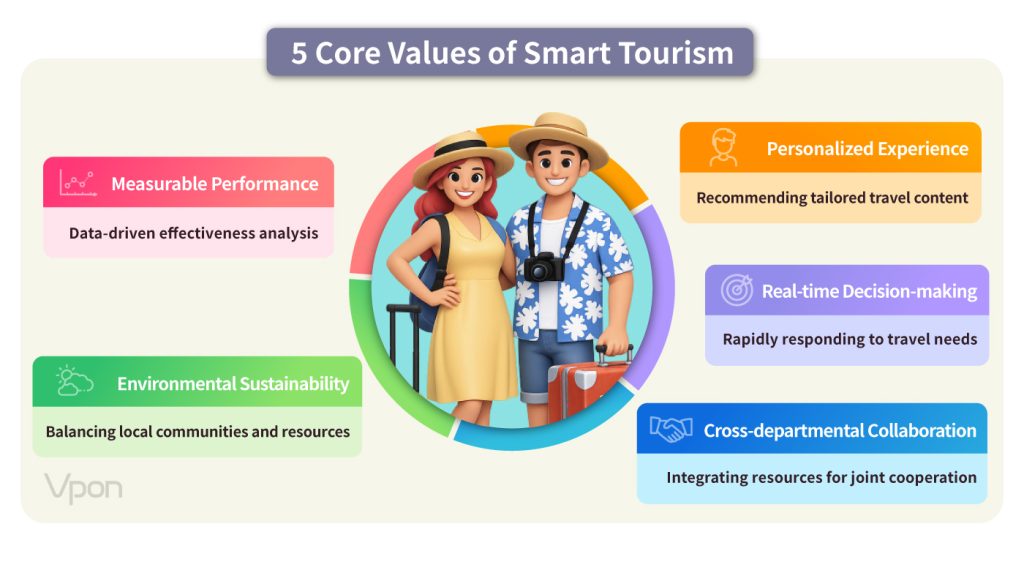
Five Core Values of Smart Tourism
Personalized Experiences:
Recommending tailored travel content based on travelers’ interests and preferencesReal-Time Decision-Making:
Using real-time data to quickly respond to visitor flows and unexpected situations- Cross-Sector Collaboration:
Enabling smoother cooperation among different organizations and departments - Environmental Sustainability:
Managing tourism development while balancing local community interests and resource protection - Measurable Outcomes:
Using data to evaluate economic impact and actual results
How Digital Transformation (DX) Elevates the Travel Experience
Digital transformation (DX) improves the travel experience by making trips smoother and easier from start to finish. By using technologies such as Artificial Intelligence (AI), Big Data, and the Internet of Things (IoT), digital transformation helps tourism move away from general services and toward more personalized travel experiences.
Before a trip, travelers can discover destinations more easily through AI-powered recommendations based on their interests and past travel behavior. During the journey, digital transformation improves transportation and convenience through tools like Mobility as a Service (MaaS) and contactless technology, including digital boarding passes and biometric check-ins. These solutions reduce waiting time and make travel less stressful.
Overall, digital transformation in tourism helps travelers feel more valued and in control. By turning complicated travel steps into simple and smooth experiences, DX creates more enjoyable, memorable, and stress free journeys.
*Note: “Mobility as a Service (MaaS)” refers to a user-centric approach that integrates and manages all transportation services through a single digital interface, fulfilling travelers’ end-to-end mobility needs.
2. Taiwan Tourism 2030 Vision: A Transformation Engine Driven by Data Governance
From a “Pandemic Prevention Model” to a “Tourism Nation”: Ten Million Visitors and a Trillion-Dollar Industry
Taiwan aims to transform from a “Pandemic Prevention Leader” into a “Major Tourism Nation.” In Taiwan’s Tourism 2030 Policy White Paper, Taiwan plans to attract more than 10 million international visitors and create over NT$1 trillion in tourism revenue by 2030. To reach this goal, the government promotes Tourism Mainstreaming, which means tourism goals are included in all major policies, from transportation and culture to urban development.
Dual Drivers: Sustainability and Resilience × Digital Innovation
Tourism 2030 is not simply about increasing visitor numbers. Instead, it views digital transformation as the key driving force behind tourism upgrades. By developing smart attractions, integrated tourism platforms, and AI-powered management systems, the government aims to improve overall service quality while delivering smoother and more personalized travel experiences.
Smart management platforms, upgraded tourism information systems, and data-driven marketing mechanisms allow tourism authorities to better understand traveler behavior and respond to their needs in real time. This approach can further enhance travel quality, extend visitor stay duration, and increase average daily spending.
Digital Governance: An AI-Powered Intelligent Decision Center
Digital governance forms the foundation of smart tourism. By integrating systems across different departments into a unified data platform, AI technologies can empower tourism operations—from visitor flow management and tourism trend forecasting to automated customer service support—making tourism management more efficient and intelligent.
3. Measuring Smart Tourism Performance: The Next Generation of Key Performance Indicators (KPIs)
Rethinking Tourism Metrics
Measuring tourism is no longer just about counting visitors. While arrival numbers are still important, success in 2030 will focus on understanding traveler behavior and creating meaningful experiences. Near real-time data management helps destinations see how visitors interact with attractions, services, and local businesses.
What Defines the Core of Tourism Performance?
Tourism performance depends not only on the scale of visitor flows, but also on the level of traveler engagement and whether digital tools effectively guide the entire journey.
Through Vpon’s tourism big data platform, tourism authorities can evolve from simple data reporting to data-driven decision management, focusing on the following key dimensions:
Traffic Hotspots & Dwell Time
Tracking traveler movement patterns and the amount of time visitors spend at popular attractions helps optimize crowd management while maintaining a positive travel experience.Online-to-Offline Attribution (O2O Visitor Flow Tracking)
By connecting online advertising exposure with actual visits, destinations can clearly map the conversion path from initial interest to real-world action, creating a verifiable performance measurement model.Economic Impact Evaluation & Standardized KPI Dashboards
Through a shared tourism data platform, governments can clearly identify the economic contributions of different traveler segments, such as high-value or premium travelers.
Under a unified framework of standardized KPIs and centralized dashboards, government agencies can operate using the same data logic when implementing and evaluating policies, ensuring consistency in performance comparisons. When key information—such as traveler spending, visitor profiles, pre-trip and in-trip behaviors, and accommodation data—is integrated into a single platform, policy planning, marketing execution, and performance measurement become significantly more precise.
This approach effectively eliminates data silos and prevents discrepancies caused by different departments interpreting data separately.
Within a “Single Source of Truth” framework, tourism decisions can be based on clear and consistent data foundations, ensuring that every strategy and resource investment generates measurable and verifiable outcomes.
4. How City-Level Experiences Amplify Brand Value
Upgrading from a “Location” to a “Destination”
Within the framework of smart tourism, a city is no longer just a geographic coordinate—it becomes a destination with brand value. Through city branding strategies supported by data governance, cities can elevate local districts into internationally recognized tourism hubs.
With a well-established data governance mechanism, municipal governments can more clearly understand the profiles of target travelers and precisely promote cultural venues, natural landscapes, and other distinctive local resources to the audiences most interested and with the highest potential.
Case Study: The Concert Economy — Expanding City Brand Value Through Big Data
Taking the recently discussed “concert economy” as an example, the city of Kaohsiung has transformed the large but short-term visitor flows generated by international concerts (such as the Blackpink world tour) into long-term and sustainable tourism value.
Kaohsiung has moved beyond a “ticket-only economy,” using these events to further stimulate citywide economic growth, extend the average length of stay for travelers, and encourage repeat visits from both domestic and international tourists.
Four Key Strategic Approaches
Rather than adopting traditional large-scale exposure marketing, Kaohsiung reshaped its marketing strategy through data-driven smart tourism solutions across multiple dimensions:
- Behavioral Analysis
By mapping the movement trajectories and high-density dwell zones of visitors across the city, this component produces an empirical behavior map of concert-going travelers — capturing entry routes into the city, time spent at attractions, and the spatial distribution of consumer activity — to serve as the data foundation for all subsequent strategic planning. - Strategic Diversion
Drawing on the crowd concentration nodes identified through behavioral analysis, this component proactively engineers “dispersal incentives” by combining curated urban light installations, thematically cohesive visual programming, and localized promotional offers. The aim is to systematically redirect foot traffic away from the concert venue and toward destinations such as the Pier-2 Art Center, Cijin Island, and local cultural and commercial districts — achieving a shift from “single-point saturation” to “multi-node shared prosperity.” - Digital Integrated Marketing
This component upgrades the conventional promotional model — previously centered on event-by-event exposure — into a cross-platform travel experience design. By integrating digital map recommendations, social media check-in routes, and online discount vouchers, visitors are kept in continuous engagement with the city brand before arrival, throughout their stay, and after departure, effectively extending the digital touchpoints of the travel experience. - AI-Powered Audience Targeting
Once visitor behavior profiles have been established, AI models are deployed to proactively reach audiences who have yet to visit — targeting high-spending travelers from other regions of Taiwan, or leveraging cross-border data analysis to identify prospective visitors in international markets such as Hong Kong and Southeast Asia who hold dual interest in both live concerts and urban tourism. This expands the city’s brand presence well beyond its existing traffic ecosystem.
In recent years, Kaohsiung’s key city marketing strategy—the “concert economy”—has demonstrated how big data can upgrade the travel experience for fans. Attending a concert is no longer just a one-day itinerary. Fans shift from passive participants to active contributors to the city’s economy. During major concerts, the tourism bureau leverages high visitor traffic and combines digital map recommendations, social media check-in routes, and local promotional offers to guide crowds from a single venue into multiple urban areas.
This approach expands economic impact from a single point to a broader city-wide network, ensuring that the concert economy does not remain limited to the venue’s surroundings but instead becomes a shared tourism driver and source of consumption growth across the entire city. As a result, it creates a multiplier effect that benefits both the public sector and private businesses.
Business Outcomes
The combination of big data and large-scale entertainment events has generated significant economic benefits for Kaohsiung:
Immediate Revenue Growth
More than 120,000 visitors within two days, generating over NT$300 million in economic value.Local Business Growth
Night market revenues increased by approximately 30%, while hotel occupancy rates and spending on dining and accommodation rose significantly.Infrastructure Utilization
Public transportation usage reached a record high, validating the effectiveness of the city’s visitor flow management strategy.Long term Scalability
A successful scalable smart tourism model was established, transforming short-term event traffic into long-term momentum for city brand enhancement and marketing efficiency.
Data-Driven Governance: From Insight to Impact
Within the framework of smart tourism development, the value of data goes beyond marketing exposure and event promotion. It becomes the core engine for urban decision-making and operational optimization.
When traveler footprints, consumption behaviors, and interaction data are effectively integrated and analyzed, cities can transform abstract data assets into actionable governance strategies and growth momentum. From transportation management and visitor safety monitoring to cross-platform audience engagement and international brand positioning, data can significantly enhance urban competitiveness and the sustainability of tourism development.
The following three areas represent key practices for applying data in smart city and smart tourism governance:
- Strengthen City Branding
Using AIR (Audience Insight Report) to understand travelers’ digital profiles, preference attributes, and areas of interest, enabling more focused and precise city brand communication and promotion. - Smarter Urban Operations
Using data maps to optimize transportation planning and manage both pedestrian and vehicle flows during large-scale events, improving urban efficiency and safety. - Precision Retargeting
Through Vpon’s Audience Center, GA4 website data and LINE Official Account interaction data are integrated into a single platform. This enables precise segmentation and cross-platform campaign deployment, supporting audience targeting and repeat-visit strategies.
In the next episode, we will explore how AI can power the next generation of smart tourism — reshaping the traveler’s journey through a fully personalized experience.
👉Read full story:
Smart Tourism of the Future: Reshaping the Tourism Ecosystem with AI and Big Data (Part II)